The Directorate General of Taxes is an Echelon I Unit under the Ministry of Finance. In general, official websites of RI Government ministries/agencies end in .go.id
Secure websites using HTTPS display a (lock) icon. Website addresses starting with https:// are a form of security, indicating that the data flow and communication between your browser and the website server is encrypted.
Periodic Tax Return Management
Tax Return management is a tax administration process that supports the receipt and processing of Tax Returns (SPT) from Taxpayers. Through this service, Taxpayers can prepare, submit, and monitor tax reporting in a more structured and documented manner.
The information presented on this page may change in line with the latest tax regulations and the system development process.
[Update 06/10/2025]
Tax Return Management Business Process
Updated 20 Nov 2026
Overview of the Tax Return Management Business Process
The Tax Return management business process is a series of tax administration activities related to the receipt and processing of Tax Returns submitted by Taxpayers. The objectives of this process are:
to improve the efficiency of Tax Return receipt and processing; and
to provide convenience for Taxpayers in fulfilling their Tax Return submission obligations.
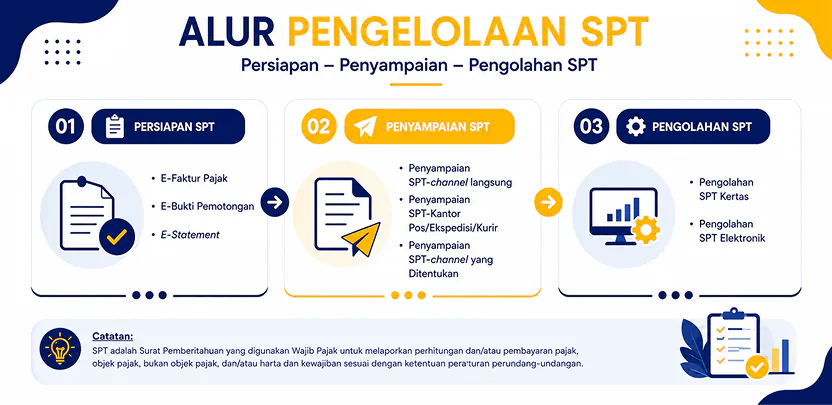
The Tax Return management business process consists of three main business processes, namely:
Tax Return Preparation;
Tax Return Submission; and
Tax Return Processing.
Tax Return Preparation
Tax Return preparation is the process of preparing the electronic documents that support the Tax Return. The three electronic documents that Taxpayers prepare electronically are:
e-VAT invoice (e-Faktur)
supporting document for the Periodic Tax Return
e-withholding tax slip (e-Bupot)
supporting document for the Periodic Tax Return
financial statements and gross turnover recapitulation (e-statement)
supporting document for the Annual Tax Return
Tax Return Submission
Tax Return submission is the activity of receiving Tax Returns submitted by Taxpayers or other parties authorized by Taxpayers through the available channels: directly to the Tax Office (KPP), through the post office/courier to the UPDDP, or other channels determined by DJP (internet portal), in the form of paper (manual) Tax Returns and electronic Tax Returns.
Tax Return Processing
Tax Return processing is the activity of reviewing and recording Tax Returns received from Taxpayers, both paper (manual) Tax Returns and electronic Tax Returns.
Reasons for Changes to the Tax Return Management Business Process
Before Coretax was implemented, the Tax Return management business process faced challenges such as:
An imperfect process for reviewing the completeness of Tax Returns upon receipt, so a number of incomplete Tax Returns were received and issued a Letter Receipt Proof (BPS). This was caused by:
the still large number of paper Tax Return reports, which creates an excessive burden on Tax Return receipt, especially at the end of the Annual Tax Return reporting period;
the complexity and diversity of Tax Returns, because each type of Tax Return has specific user provisions and filling procedures that differ for each type of Tax Return.
Processing paper Tax Returns takes a long time, which is one of the weaknesses of the manual reporting medium (paper Tax Returns).
The absence of data integration or use of third-party systems to help validate tax documents.
Taxpayers need a long time to prepare, fill in, and submit Tax Returns because there is no integrated system for Taxpayers from the preparation and filling stages through to submission.
Many Taxpayers who do not meet the objective requirements still submit Tax Returns because of a lack of clear rules for Taxpayers regarding the criteria for Taxpayers who do not need to submit Tax Returns.
Taking the above challenges into account, the Tax Return Management business process with the Core Tax Administration System Renewal has changed as follows:
The entire Tax Return process, from preparation and submission through to processing and tax payment, is simplified and integrated in a single application window.
Digitalization and automation of the validation of pre-filled data from the main data sources (for example: DJBC, Peruri, online reporting obligations).
Redesign of the Tax Return form (including simplification, standardization, and structuring of Tax Return attachments).
The obligation to submit Tax Returns online, except for Annual Individual Income Tax Returns of non-employees with nil or underpaid status.
Elimination of the procedure for requesting Tax Return completeness. An incomplete Tax Return will be issued a Letter stating that the Tax Return is Considered Not Submitted.
Enforcement of the criteria used as the limit for Individual Taxpayers who are exempted from submitting Tax Returns (Exempted From Filing, hereinafter referred to as EFF).