
Revising GR-55/2022: No Longer Staying “Small on Paper” for MSMEs
Oleh: (Timon Pieter), Tax Educator, Directorate General of Taxes (DJP)
The government’s plan to revise Government Regulation Number 55 of 2022 (GR-55/2022) on final income tax for micro, small, and medium enterprises (MSMEs) has stirred familiar debate. Some fear that the reform will burden small firms, while others argue it will improve fairness.
Yet the issue is more fundamental than simply weighing who pays more or less. If left unrevised, the current rule risks trapping Indonesian MSMEs in a condition where they remain “small on paper” even when their real economic scale has already grown.
Final Tax Misuse
Turnover-based taxation was introduced to simplify compliance and encourage formalization—goals that are vital for a developing economy. However, global and domestic evidence consistently shows that turnover thresholds also distort taxpayer behavior.
Public reports show that Directorate General of Taxes (DGT) has observed misuse of the 0.5 percent final tax. They often create incentives to underreport revenues, split businesses, or strategically manage turnover to stay below the limit.
Under GR-55/2022, firms with turnover up to Rp4.8 billion may apply a 0.5 percent final tax, while individual entrepreneurs enjoy an exemption for the first Rp500 million. The rule is simple, but the threshold operates like a tax cliff: once a business exceeds it, tax treatment becomes less favorable.
This cliff effect drives two well-documented behaviors. The first is bunching, where firms intentionally report just below the threshold to keep enjoying the lower rate. Research from Pakistan by Kleven and Waseem (2013) shows taxpayers clustering right below tariff jumps —not because their businesses are truly small, but because figures are strategically adjusted.
The second is firm splitting, where a growing business is divided into several smaller entities to retain eligibility for concessions. Studies in Japan (Onji, 2009) and Europe (Massenz, 2025) demonstrate how common this practice can be.
Indonesia is not immune to these distortions. Long before the issuance of GR-55/2022, studies found that MSMEs delayed sales, adjusted invoice timing, and modified turnover reporting in response to previous thresholds (Nurfauzi, Nuryakin, and Putra, 2019). Other research showed that the primary response to turnover caps was administrative rather than economic (Himawan, 2020). Firms changed how they reported, not how they operated.
Experience from abroad reinforces the concern. In South Africa (Boonzaaier et al., 2019), taxpayers were found to manipulate turnover to remain under tax cliffs. In the United Kingdom (Adam et al., 2021), self-employed individuals respond strongly to such thresholds because they can easily alter reported income.
If these behaviors emerge in advanced tax systems, they are even more likely in Indonesia, where MSMEs often operate informally or within family networks.
Policy Recommendation
Importantly, the tax authority itself has confirmed the problem. Public reports show that the DGT has observed misuse of the 0.5 percent final tax, including businesses whose actual turnover exceeds the threshold, but continue to claim MSME treatment by distributing revenues across multiple entities. This is a clear sign that the system is being gamed. The DGT has therefore emphasized the need to tighten turnover aggregation rules and strengthen the concept of beneficial ownership to prevent manipulation.
The International Monetary Fund (IMF) offers useful guidance here. IMF analysts note that while turnover taxes help early-stage formalization, they create strong incentives to misreport when the gap between the simplified and normal regimes is too wide.
Their technical recommendations include designing gradual exit mechanisms to prevent abrupt tax jumps, aggregating turnover by beneficial ownership to stop artificial splitting, and tightening eligibility criteria to ensure the simplified regime is used only by businesses that genuinely qualify (Wei and Wen, 2023). Indonesia’s current MSME scheme does not yet fully reflect these safeguards, which makes the proposed revision both timely and necessary.
Revising GR-55/2022 for Good
Public concern often centers on the fear that changing GR-55/2022 will burden MSMEs. But true support for small businesses cannot be built on policies that encourage them to stay artificially small. A tax regime that rewards stagnation ultimately harms the very people it intends to help.
Revising GR-55/2022 would reduce incentives for MSMEs to hold back their growth simply to retain favorable tax treatment. It will also support Indonesia’s Coretax modernization, which depends on accurate turnover data for effective risk analysis and compliance evaluation.
When firms misreport their size, the entire data-driven system is undermined. Eliminating opportunities for larger firms to disguise themselves as MSMEs would also strengthen fairness by ensuring tax benefits reach those who truly need them.
Most importantly, a clearer and more credible MSME tax framework will encourage small businesses scale up in a healthier way. Simplified regimes should function as stepping stones, not permanent shelters. As MSMEs grow, they should transition naturally toward better bookkeeping, greater transparency, and eventually the standard tax regime. A well-designed reform helps enable this progression.
Conclusion
The evidence is overwhelmingly consistent: turnover thresholds shape taxpayer behavior, often in ways that undermine policy goals. Indonesia is no exception. The misuse of the 0.5 percent scheme, acknowledged by the tax authority itself, shows that the system requires refinement—not abandonment.
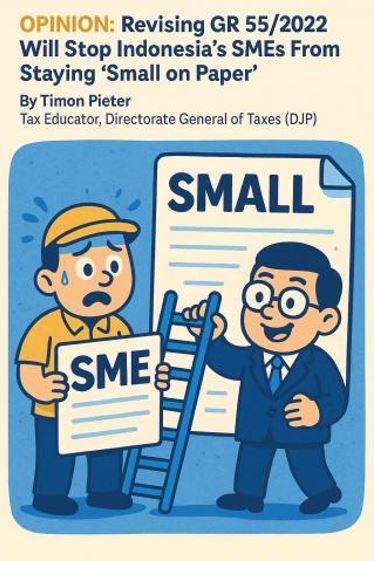
Revising GR-55/2022 is therefore not a step backward for MSMEs. It is a necessary correction to ensure that the tax system promotes genuine growth, strengthens data integrity, and narrows opportunities for manipulation. If done well, the reform will transform taxation from a ceiling that suppresses business expansion into a ladder that helps Indonesian MSMEs climb higher
*)Artikel ini merupakan pendapat pribadi penulis dan bukan cerminan sikap instansi tempat penulis bekerja.
Konten yang terdapat pada halaman ini dapat disalin dan digunakan kembali untuk keperluan nonkomersial. Namun, kami berharap pengguna untuk mencantumkan sumber dari konten yang digunakan dengan cara menautkan kembali ke halaman asli. Semoga membantu.
- 611 views